Horizon Europe · HORIZON-CL4-2023-DIGITAL-EMERGING-01-01 · Grant No. 101133807

RoboSAPIENS: Open-Ended Safe and Trustworthy Self-Adaptation for Autonomous Robots

Reconciling open-ended self-adaptation with trustworthiness by design — enabling robots to adapt their behaviour to drastic and unpredicted changes while maintaining safety, robustness and performance

Project Duration: 36 months · Consortium: 10 Partners from 8 Countries

Proposal Figures

Key Proposal Figures

The following figures are extracted from the RoboSAPIENS project proposal, illustrating the core architecture, methodology, and work package structure.
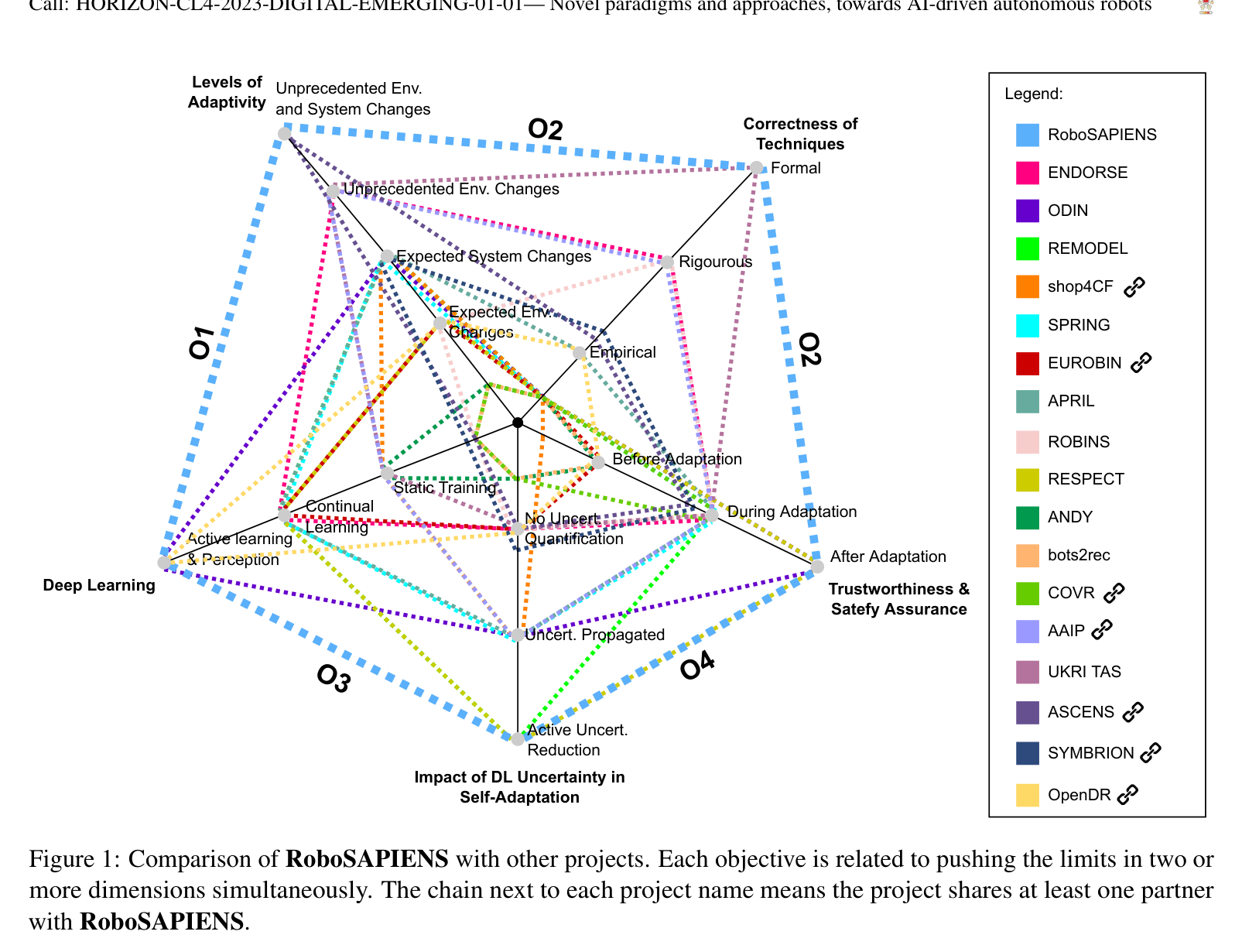
RoboSAPIENS comparison with related projects across five dimensions

Figure 1: RoboSAPIENS vs. Related Projects

Comparison across five dimensions: Trustworthiness & Safety Assurance, Levels of Adaptivity, Correctness of Techniques, Deep Learning, and Active Uncertainty Reduction. Each objective pushes limits in two or more dimensions simultaneously.
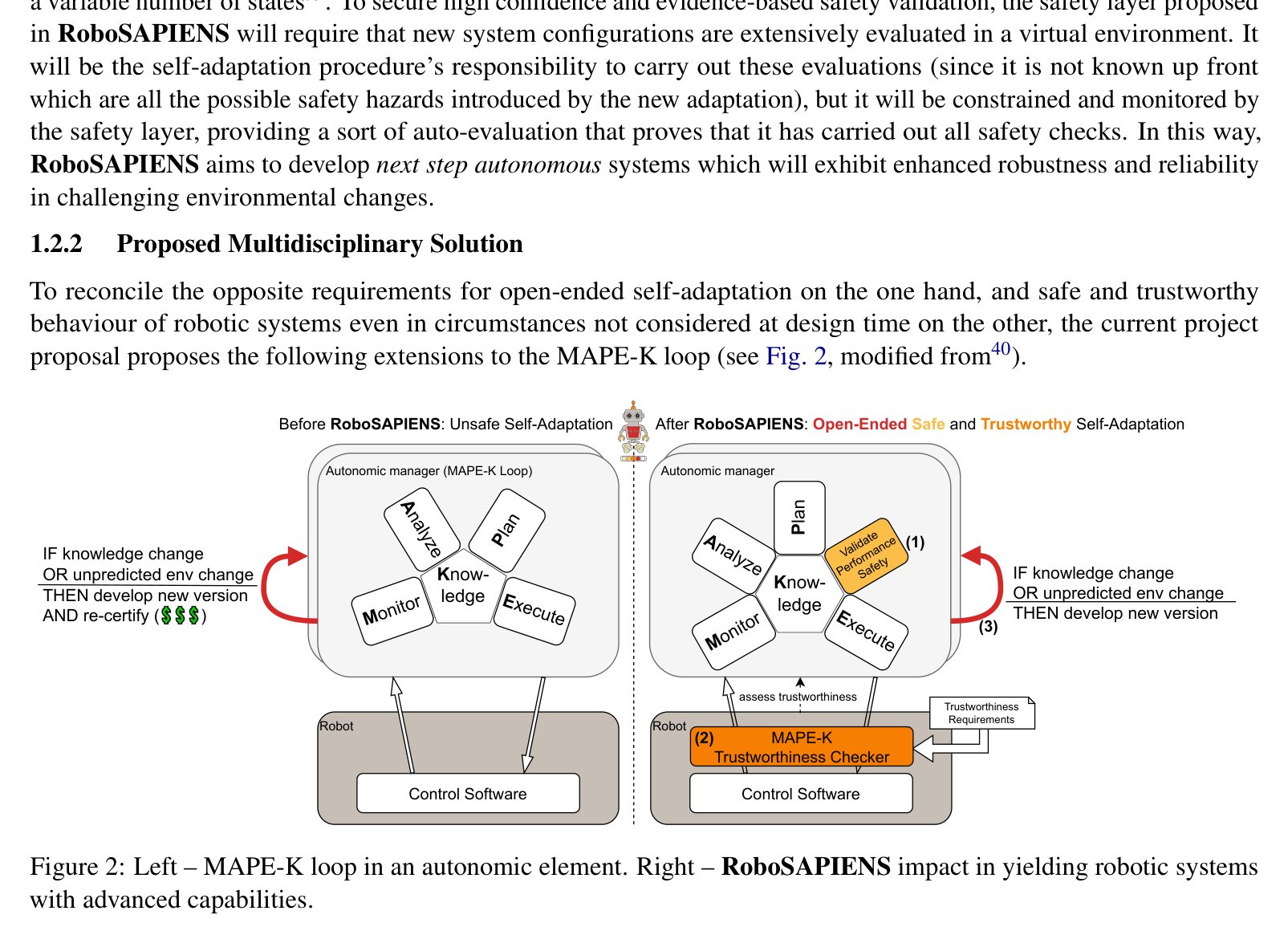
MAPE-K loop before and after RoboSAPIENS with trustworthiness checker

Figure 2: MAPE-K Loop — Before & After RoboSAPIENS

Left: traditional unsafe MAPE-K self-adaptation. Right: RoboSAPIENS adds a Validate Safety & Performance function and a MAPE-K Trustworthiness Checker for open-ended safe and trustworthy self-adaptation.
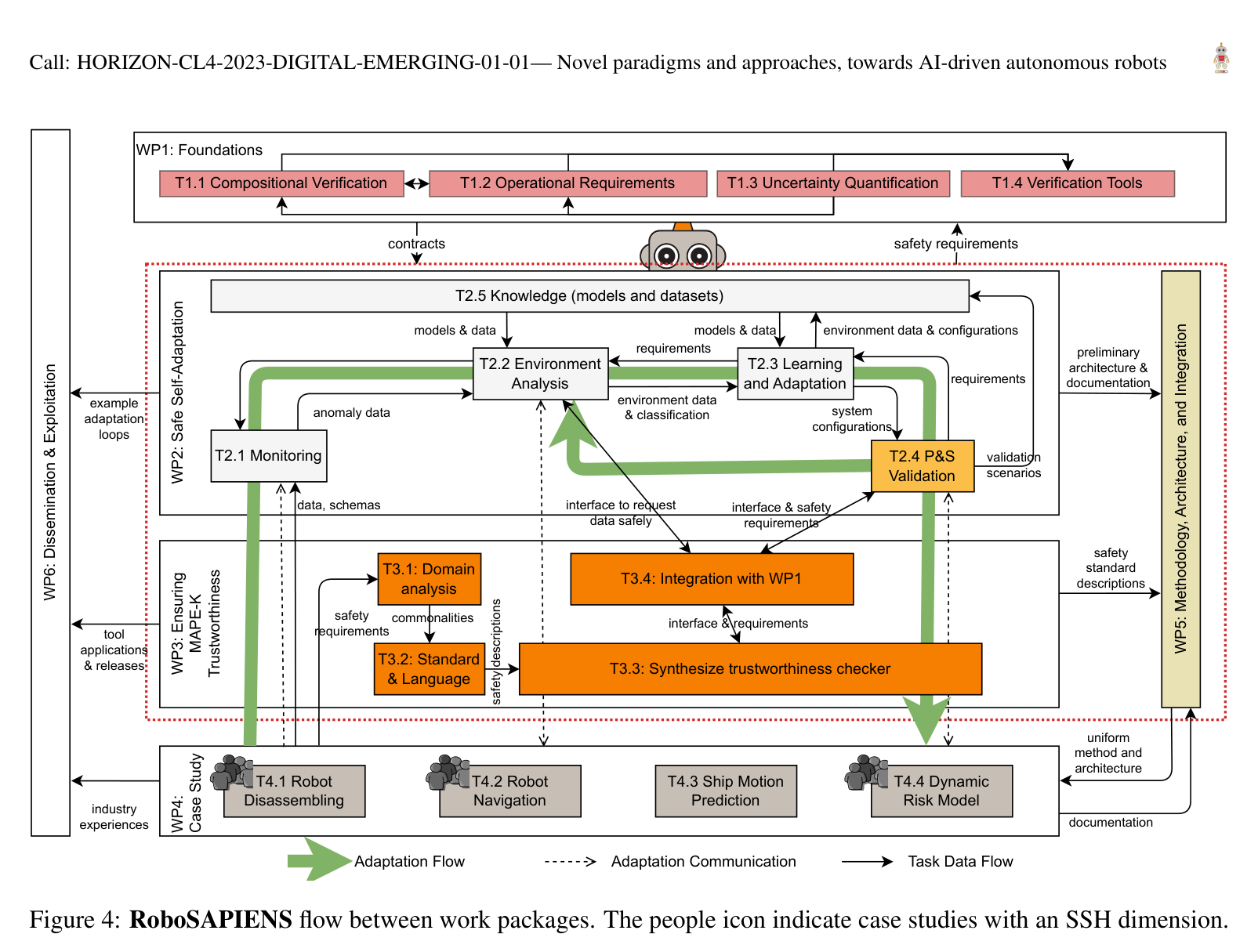
RoboSAPIENS work package flow and task interactions

Figure 4: Work Package Flow

Data and adaptation flow between WP1 (Foundations), WP2 (Safe Self-Adaptation), WP3 (Trustworthiness), WP4 (Case Studies), WP5 (Architecture), WP6 (Dissemination), and WP7 (Management).

NTNU Responsibilities and Objectives

In RoboSAPIENS, NTNU (Norwegian University of Science and Technology) leads WP4: Industrial Case Studies and contributes to multiple work packages with expertise in digital twins, co-simulation, and maritime systems.

  • WP4 lead (Case Studies): Lead the industrial case studies work package, coordinating four diverse use cases across remanufacturing, fleet management, ship motion prediction, and dynamic risk modelling.
  • Ship Motion Prediction case study (T4.3): Investigate transfer learning for ship motion prediction using the Gunnerus research vessel, combining dynamic models with limited real data for safe autonomous navigation.
  • WP2 contribution: Develop dynamics-driven system monitoring and uncertainty assessment for the MAPE-K self-adaptation loop.
  • WP3 contribution: Support domain analysis and trustworthiness checker development for maritime applications.
  • WP5 contribution: Contribute to MAPE-K loop deployment and RoboSAPIENS platform architecture.
  • Education & training: Integrate RoboSAPIENS results into courses on Digital Twin Technology, Advanced Simulation and Analysis of Maritime Operations, Real-time AI for Robotics, and Applied AI and Control.
Research

Work Packages

Seven interconnected work packages driving safe and trustworthy robotic self-adaptation

WP1

Foundations for Open-Ended Self-Adaptation

Develop mathematical theories and formal techniques for compositional verification, operational requirements, uncertainty quantification, and prototype verification tools.

Read more →
WP2

Enabling Open-Ended Safe Self-Adaptation

Develop tools for the MAPE-K loop: monitoring, active environmental state analysis, autonomous learning and adaptation, safety and performance validation, and knowledge modelling.

Read more →
WP3

Ensuring MAPE-K Trustworthiness

Develop methods to produce MAPE-K trustworthiness checkers through domain analysis, standard definition, synthesis of verified checkers, and integration with the adaptation loop.

Read more →
WP4

Industrial Case Studies

Evaluate adaptation technologies across four domains: robot disassembling, robot navigation, ship motion prediction, and dynamic risk modelling in Industry 4.0.

Read more →
WP5

Methodology, Architecture & Integration

Develop the RoboSAPIENS platform integrating results from WP2 and WP3 into a reference embedded architecture for robotic adaptivity, with workflow and elaborated examples.

Read more →
WP6

Dissemination & Exploitation

Raise awareness, disseminate results among stakeholders, liaise with Digital Innovation Hubs, and lay out the roadmap for exploiting project results through the INTO-CPS Association.

Read more →
WP7

Management

Overall project management including quality assurance, risk management, innovation monitoring, requirements management, and progress and cost reporting.

Read more →
Use Cases

Industrial Case Studies

Four industry-scale use cases demonstrating safe robotic self-adaptation across diverse domains

UC1

Robotic Remanufacturing (DTI)

Self-adapting force-based manipulation primitives for human-robot collaboration in laptop disassembly remanufacturing, adapting to parts in different conditions using expert demonstrations.

UC2

Autonomous Mobile Robots (PAL)

Fleet of TIAGo robots on the shop floor with dynamic self-adaptation for navigation, task scheduling, and safety when robots enter/leave the fleet or floor plans change.

UC3

Ship Motion Prediction (NTNU)

Transfer learning for ship motion prediction using the Gunnerus research vessel, combining dynamic models with limited data to adapt to structural changes like hull prolongation.

UC4

Dynamic Risk Model (Fraunhofer)

Dynamic human-robot safety model using sensor data and machine learning to automatically assess and adapt risk in collaborative assembly tasks in Industry 4.0.

Ambition

Five Dimensions of Innovation

RoboSAPIENS pushes the state-of-the-art across five interconnected dimensions

01

Trustworthiness & Safety Assurance

Incorporate functional safety measures into the MAPE-K loop, ensuring system-level safety properties can be verified and monitored during self-adaptation.

02

Levels of Adaptivity

Tackle both structural and environmental changes including humans, with safety observation and validation split across the robot and its runtime Digital Twin.

03

Correctness of Techniques

Formalise the layered robotic architecture and MAPE-K architecture with unified formal semantics handling data, reaction, time, and uncertainty.

04

Deep Learning

Develop active learning and active perception approaches, addressing catastrophic forgetting and distribution shifts in a holistic DL-based self-adaptation pipeline.

05

Active Uncertainty Reduction

Develop novel uncertainty quantification metrics for DL models in robotic systems, with mechanisms to actively reduce uncertainties during operation.

Contact

Get in Touch

For questions about the RoboSAPIENS project, reach out to our coordination team

Prof. Peter Gorm Larsen (Project Coordinator)

📍

Coordinating Institution

Aarhus University (AU)
Department of Electrical and Computer Engineering
Denmark

🎓

NTNU Contact

Prof. Houxiang Zhang
NTNU — Norwegian University of Science and Technology
Department of Ocean Operations and Civil Engineering
Larsgårdsveien 2, 6009 Ålesund, Norway
Email: hozh@ntnu.no

🌐

Programme

Horizon Europe — HORIZON-CL4-2023-DIGITAL-EMERGING-01-01
Novel paradigms and approaches, towards AI-driven autonomous robots

Send us a Message

Consortium

Project Partners

A strong consortium of 10 partners from 8 countries across academia, research institutes, and industry